Do Humans Review Your ChatGPT Chats? Yes — and How to Limit It
Yes — OpenAI's systems and reviewers can read ChatGPT chats for safety and training, and deleted chats stay up to 30 days. What actually protects you.
Yes — by default, your ChatGPT conversations can be examined by OpenAI's automated systems and, in some cases, human reviewers — for safety, abuse detection and to improve the models. Unless you opt out, your exchanges can also be used for training. And even deleted or temporary chats are kept for up to 30 days for abuse monitoring before they're removed. A setting reduces the training use, but the only certain protection is not entrusting the sensitive data in the first place.
What OpenAI does with your ChatGPT chats
Several processes coexist. Automated classifiers scan exchanges; flagged content can be routed to human reviewers (trust and safety) to enforce the usage rules. Separately, AI trainers may read excerpts to improve the system. And for cases deemed serious — an imminent threat of serious harm to others — OpenAI says it may refer the matter to law enforcement. So “a human can read a portion” is accurate.
Limit the training use: the setting
You can reduce collection in a few steps:
- 1Settings → Data Controls → turn off “Improve the model for everyone”: your future exchanges stop feeding training.
- 2Delete past conversations or use Temporary Chat (kept up to 30 days, then erased).
- 3Keep in mind that turning training off stops neither safety review nor the 30-day retention tied to abuse monitoring.
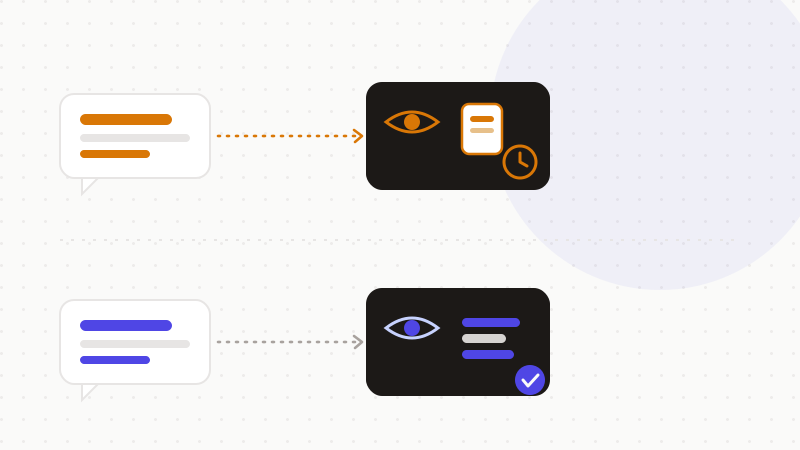
What the setting doesn't cover
Even with training off, OpenAI keeps conversations to run and protect the service, and flagged content can still be reviewed by people; deleted or temporary chats persist up to 30 days. A setting reduces a use; it doesn't undo the fact that the data was transmitted.
| You assume | The reality |
|---|---|
| “Only a machine reads my chats” | Flagged content can be reviewed by people |
| “I delete it, it's gone” | Deleted and temporary chats kept up to 30 days |
| “Opting out of training stops everything” | Safety review and operational retention remain |
The fix: don't entrust sensitive data
Since neither review nor retention is fully under your control, the only guarantee is about the content: if the conversation contains no sensitive data in the clear, neither a reviewer nor 30-day storage exposes anything usable.
- Do the setting: it's good basic hygiene.
- But don't rely on it for truly sensitive data.
- Remove names, identifiers and secrets before sending.
That's exactly what ONYRI Sanitize is for: the engine replaces sensitive data with reversible tokens before sending; detection and the mapping stay in your browser, and only anonymized text reaches ChatGPT. Whether a reviewer looks or the conversation is retained, it only finds tokens — not your real information.
Frequently asked questions
- Do humans really read my ChatGPT conversations?
- Yes, a portion: OpenAI combines automated systems with authorized human reviewers for safety and rule enforcement, and AI trainers may read excerpts to improve the models. That's why OpenAI advises against sharing sensitive information.
- Does deleting a ChatGPT conversation remove it right away?
- Not immediately: deleted and temporary chats are kept up to 30 days for abuse monitoring before removal. Deletion empties your visible history first, not that safety window.
- How do I use ChatGPT without exposing my data?
- Turn off “Improve the model for everyone” to limit training, but above all anonymize sensitive data before sending: an engine replaces it with a reversible token, and ChatGPT never receives the real information.
Sources & references
Keep your sensitive data in your browser
ONYRI Sanitize detects and masks your sensitive data before it reaches the AI, then restores the answer — from names to API keys.
Anonymize my prompt