Claude now trains on your conversations: how to opt out
Since 2025, consumer conversations with Claude train the models unless you opt out, with retention extended to 5 years. How to opt out, and what protects you.
Since a 2025 update to its consumer terms, Anthropic uses conversations and coding sessions with Claude to train its models by default — unless you explicitly opt out. The setting is on by default, and retention for the data involved jumps from 30 days to five years. You can opt out in two minutes; but the strongest protection remains not entrusting sensitive data to the tool, opt-out or not.
What Anthropic changed
On August 28, 2025, Anthropic announced an update to Claude's consumer terms and privacy policy. Now, unless you opt out, your chats and coding sessions can be used to train and improve the models. The choice is left to the user, but the option is on by default: it takes a manual action to turn it off. And if you leave the use enabled, retention rises to five years for new or resumed conversations — a major jump from the previous 30 days.
Opting out: the setting in practice
Taking back control comes down to a few steps:
- 1Open Claude's privacy settings and find the option for using data for training.
- 2Turn it off: your conversations then aren't used to train the models.
- 3Check the scope: offerings governed by commercial terms (teams, government, education, API access via third parties) aren't affected by this consumer change.
Why opting out isn't always enough
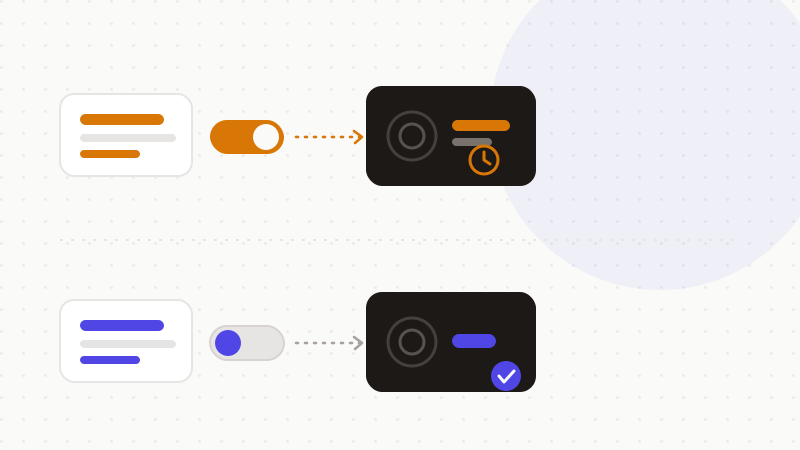
Opting out is a good reflex, but it's a provider-side setting you can neither verify nor prove. It can be misapplied, forgotten when you switch devices, or changed by a future terms update — as this one showed. And even opted out, your text is still transmitted and processed. Opting out reduces a use; it doesn't remove the send.
| Setting / assumption | Reality |
|---|---|
| Training: “I didn't enable anything” | On by default — you must actively opt out |
| “It's kept 30 days” | Up to 5 years if the use is left enabled |
| “My opt-out is permanent” | A provider setting can change with the terms |
The fix: anonymize upstream
What depends on no checkbox is what you don't send. If the sensitive data never leaves your browser, no training policy, present or future, can apply to it.
- 1Opt out of training: it's useful and recommended.
- 2But don't bet everything on it for truly sensitive data.
- 3Remove identities, identifiers and secrets before sending, and keep the token↔value mapping local.
That's what ONYRI Sanitize does: the engine detects sensitive data and replaces it with reversible tokens before sending; detection and the mapping stay in your browser, and only anonymized text reaches the AI. Whether or not Claude trains on the conversation, it only has tokens to learn — not your real information.
Frequently asked questions
- Does Claude use my conversations to train?
- Since the 2025 consumer terms update, yes by default: unless you opt out, your chats and coding sessions can be used to train the models. The option is on by default and is turned off manually in the privacy settings.
- How long does Anthropic keep my data?
- If you leave the training use enabled, retention rises to five years for new or resumed conversations, up from 30 days. Opting out limits that duration.
- Does opting out fully protect my sensitive data?
- No: it's a provider-side setting, not verifiable, and it can change with the terms. Your text is still transmitted. For a real guarantee, anonymize the sensitive data before sending.
Sources & references
Keep your sensitive data in your browser
ONYRI Sanitize detects and masks your sensitive data before it reaches the AI, then restores the answer — from names to API keys.