Turning off tracking isn't enough: the Google verdict lesson
In 2025, a jury hit Google with $425.7M for collecting data despite the setting being off. The lesson: a privacy toggle is a promise, not a guarantee.
In September 2025, a U.S. federal jury ordered Google to pay $425.7 million: for years, the company kept collecting the activity of roughly 98 million users who had turned off the very setting meant to stop it (“Web & App Activity”), via third-party apps. Google is appealing. The lesson goes beyond Google: a privacy toggle is a promise, not a guarantee. As long as you hand over the data, you depend on the provider to honor your settings. The only guarantee lies in what you don't transmit.
What the court found
In Rodriguez v. Google, the jury found an invasion of privacy: according to reporting by Reuters and CNBC, Google kept gathering data from third-party apps after users disabled the setting presented as the way to stop that collection. The figure — $425.7M, a few dollars per person across a class of about 98 million — matters less than the principle established: the gap between what a setting promises and what actually happens can run for years before it's sanctioned.
A setting is a promise, not a guarantee
Turning off a tracking option doesn't physically remove the data: it asks a remote system not to record it. Between your click and the actual behavior sit code, third-party partners, legal interpretations and mistakes. The outcome depends entirely on correct execution on the provider's side — exactly what the verdict called into question.
| You assume | The reality |
|---|---|
| “I turned off tracking, nothing is collected” | The setting must be honored by the provider, and isn't always |
| “The setting covers everything” | Third-party channels can slip past it |
| “If it were false, I'd know” | The gap can run for years before it surfaces |
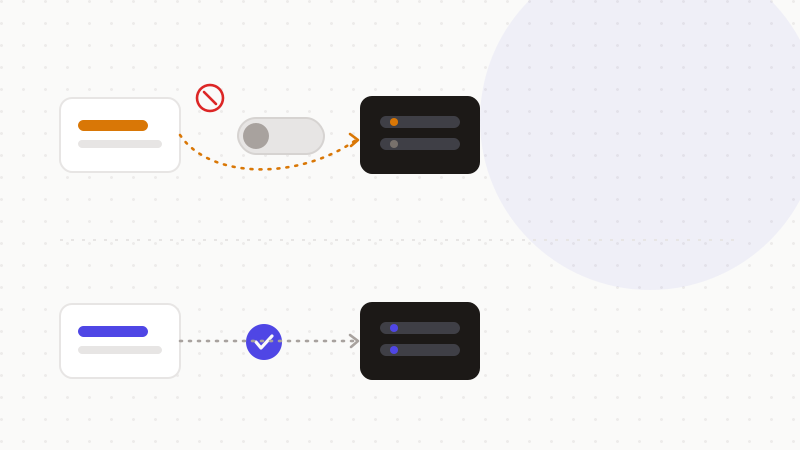
The same principle with AI
Pasting text into an AI rests on the same trust. The “don't train on my data,” “history off” or “temporary chat” options are useful — but they're provider-side settings you can neither inspect nor prove. If one is misapplied, misunderstood or changed, it's your real data on the line. And once transmitted, you can't recall it.
What you don't control, once the data is sent:
- whether the setting is actually honored, and on which channels;
- what downstream subprocessors and partners do;
- policy changes, technical logs and legal obligations.
What you actually control
Only one thing doesn't depend on a promise: what you don't transmit. If the sensitive data never leaves your device, no misapplied setting can expose it.
- 1Don't rely on a remote switch to protect sensitive data.
- 2Remove the sensitive data before sending, instead of hoping it's ignored.
- 3Keep the token↔value mapping local, out of the provider's reach.
That's ONYRI Sanitize's logic: the engine detects sensitive data and replaces it with reversible tokens before sending; detection and the token↔value mapping stay in your browser, and only anonymized text reaches the AI. You no longer depend on a provider-side setting — the real data never left in the first place.
Frequently asked questions
- What was Google accused of in this case?
- Per press reports (Reuters, CNBC), Google kept collecting data from third-party apps after users disabled the “Web & App Activity” setting meant to stop it. A jury awarded $425.7M in September 2025; Google is appealing.
- Does turning off a privacy option really protect you?
- It's an intent addressed to the provider, not a physical guarantee. The setting must be correctly honored server-side, which you can't verify. The only certain protection is not transmitting the sensitive data.
- How does this lesson apply to AI?
- Don't rely on “don't train” or “temporary chat” options for sensitive data. Anonymize the text before sending: an engine replaces the data with a reversible token, and the model never receives the real information.
Sources & references
Keep your sensitive data in your browser
ONYRI Sanitize detects and masks your sensitive data before it reaches the AI, then restores the answer — from names to API keys.