Is It Safe to Use AI for Wills and Estate Planning?
AI can help you understand estate planning, but it can't write a valid will. Never paste names, accounts or beneficiaries: anonymise before you prompt.
AI can help you understand estate planning in general terms. But a will is not a document to hand to a chatbot. A will is a map of your wealth and your family. It lists your assets, your accounts, your beneficiaries. It sometimes reveals why one person inherits nothing. This data is gold for a fraudster. It also concerns relatives who never agreed to the sharing. And a will only matters if it is legally valid. The rules for signing and witnesses are strict. They vary by country and by state. A chatbot is not a solicitor. The safe method: anonymise before you write, confirm with an official source, finalise with a professional.
A will is a map of your wealth and your family
Think about what a will contains. The list of your assets. Your accounts, and sometimes their numbers. The names of your beneficiaries. Your family ties. It is a full summary of your wealth. Paired with an account number, these details become a target for theft and fraud. That is why an account number should never enter a chatbot.
A will also speaks about other people. Your children, your partner, your relatives. This is their personal data, not only yours. They never agreed to you sharing it with an AI. The reason behind your choices is even more sensitive. Disinheriting someone. A family estrangement. A health reason. These details are deeply private.
Legal validity is the dangerous part
Here is the real trap. A will only takes effect when you die. At that point, you can no longer fix it. A mistake found too late is often impossible to repair. Well-written text is not always a valid will.
The execution rules are strict and vary a lot. The official GOV.UK guide, Making a will, says it plainly. A will must be formally signed and witnessed to be legally valid. GOV.UK also advises you to get advice if your situation is not straightforward.
These rules change from one country and state to the next. In England and Wales, the Wills Act 1837 sets them out.
- The person must be at least 18, of sound mind, and act voluntarily.
- The will must be in writing and signed before two witnesses who are physically present.
- Each witness then signs it while the maker watches.
- A witness, or their spouse, cannot inherit: that gift would be void.
- Since 31 January 2024, both witnesses must be in the same room. Remote witnessing is no longer allowed.
These rules apply to England and Wales. Scotland has its own. In the United States, each state sets its own. Most require a signature and two witnesses. Some recognise the holographic will, written by hand. Louisiana follows a different regime entirely. Never treat one country's rules as universal. Confirm the rules of your own country or state.
AI can invent the law
An AI can state a false legal rule with full confidence. This is not a hypothesis. In the United States, courts have sanctioned lawyers more than once. Their filings cited court decisions that an AI had invented.
Scientific American reports a now-famous 2023 New York case. A chatbot had produced six non-existent decisions. With fake quotes and fake case numbers. The judge imposed a 5,000-dollar fine. If an AI can invent case law, it can invent a rule about wills.
Keep one simple point in mind. A consumer chatbot is not a solicitor or a regulated adviser. It owes you no professional duty. Its answer must be checked by a qualified human before you rely on it.
What the data rules say
The Information Commissioner's Office (ICO) is the UK's data protection regulator. It explains that some personal data is 'special category'. It needs extra protection because it is sensitive. Health information is one example.
The ICO adds a key point. Information inferred about a person can itself become special category data. A will often reveals health reasons or a family rupture. It carries data about beneficiaries who agreed to nothing. Much of it stays ordinary personal data. But some elements touch the most private ground.
There is also retention. Text pasted into a third-party AI service can be kept on its servers. It can be reviewed. It can be used to train models. Your full estate plan would then outlive the single conversation.
| You assume | The reality |
|---|---|
| “An account number in the prompt is nothing” | Paired with your assets, it becomes a target for theft and fraud |
| “AI can write my final will” | Text isn't valid without the required signatures and witnesses |
| “The chatbot knows my country's rules” | It can invent a rule: confirm with an official source |
| “This data only concerns me” | It also concerns relatives who never consented |
The fix: plan with AI, finalise with a human
Good news: AI is still useful for estate planning. It can explain the broad principles. It can clarify a term or a structure. It can even improve the wording of an anonymised draft. For that, it needs no real name and no real number.
- 1Anonymise first: names, accounts, addresses and amounts become tokens.
- 2Never paste an account number, not even a partial one.
- 3Ask the AI to explain the structure or improve the anonymised text.
- 4Confirm the validity rules with an official source, such as GOV.UK, or a professional.
- 5Finalise the will with a qualified human, never with a chatbot.
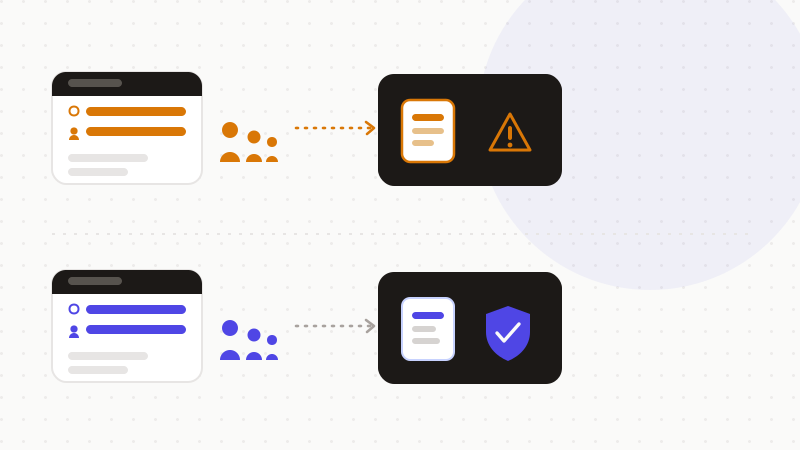
The idea fits in one line. The AI reasons about the shape of your situation. It never sees the real values. You restore the names and amounts afterwards, locally. Then you take the worked draft to a professional to make it valid.
That's what ONYRI Sanitize is for. The engine detects sensitive data — names, beneficiaries, accounts, addresses, amounts — and replaces it with reversible tokens before sending. Detection and the mapping stay in your browser. Only anonymized text reaches the model. The AI finds only tokens, never your relatives' identities or your accounts. You plan your estate with confidence, before finalising it with a professional.
Frequently asked questions
- Is it safe to use AI for wills and estate planning?
- Yes for understanding, no for the real document. AI can explain estate planning, inheritance and structure with no personal data. But never paste names, account numbers, beneficiaries or your private reasons into a consumer chatbot. And a chatbot cannot produce a legally valid will: signing and witnessing rules are strict and vary by country and state. Anonymise first, then finalise with a qualified professional.
- Can AI write a legally valid will?
- No, not on its own. AI can draft or improve wording, but a will only becomes valid when it is signed and witnessed under your jurisdiction's rules. GOV.UK's Making a will guidance stresses formal signing and witnessing, and advises getting help if your situation is not straightforward. AI can also invent legal requirements, so confirm every rule with an official source or a professional.
- What should I never paste into AI when planning my estate?
- Never paste account numbers, full names of beneficiaries, addresses, exact amounts, or private reasons such as health or estrangement. Account numbers paired with your assets are a fraud target. Beneficiary details are personal data about people who did not consent. Replace all of these with tokens before you prompt, and keep the mapping on your own device.
Sources & references
- Making a will: Overview (a will must be formally signed and witnessed to be legally valid; get advice if your will is not straightforward) — GOV.UK (UK Government)
- What is special category data? (special category data, extra protection, inferred data) — Information Commissioner's Office (ICO)
- Why Lawyers Keep Citing Fake Cases Invented by AI (AI-invented case law, sanctions, AI is not legal advice) — Scientific American
Keep your sensitive data in your browser
ONYRI Sanitize detects and masks your sensitive data before it reaches the AI, then restores the answer — from names to API keys.