Is It Safe to Use AI for Logistics and Supply Chain?
Yes for method, no with your manifest: routes, rates and customer addresses are regulated personal data and commercial secrets. Anonymise before you send.
The answer fits in one line. AI can optimise your transport plan, but not with your raw manifest. A supply chain is a map of your business. Your routes, your volumes, your carriers, your lead times. Your negotiated freight rates. Your customers' delivery addresses. Pasted into a consumer AI, that file lands on a third party's servers. Under the GDPR, a delivery address is personal data. And you stay the controller of it. Your rates can lose their secret status once disclosed. There is a clean method: anonymise before you send, and the AI still does the work.
Your supply chain is a map of your business
A logistics file looks like nothing. It's a spreadsheet. Rows, columns, codes. Yet it tells the whole story. Who supplies you. Where your flows go. What you pay per kilometre. Which customers carry weight. How fast you really deliver. A competitor would pay well for that file. It reads out your cost base and your dependencies.
Look at a single manifest line. It says more than the annual report.
- A customer's delivery address, with their name and a time window.
- The chosen carrier and the freight rate you negotiated with them.
- The route, the waypoints and the loading window.
- The shipped volume, which reveals the real size of the account.
- The promised lead time, which reveals your actual capacity.
A delivery address is personal data
The GDPR (Regulation (EU) 2016/679) defines personal data in Article 4(1). It is any information relating to an identified or identifiable person. A manifest line pairs a name, a home address and a delivery window. It sits squarely inside that definition. So a logistics file is not a neutral operational artefact. It is a file of regulated personal data.
Article 4(2) defines processing. Its list includes "disclosure by transmission" and "making available". Pasting a customer address list into a consumer AI is therefore processing in its own right. Not a step before processing. The transmission is the event that triggers the obligations.
Article 4(7) names the controller. That is whoever determines the purposes and means. Article 4(8) defines the processor, who acts on the controller's behalf. A shipper who routes customer data through an AI tool remains the controller. Article 5(2) adds accountability. You must be able to demonstrate compliance. That responsibility does not transfer to the vendor.
The GDPR is EU law, with a UK equivalent. Other regimes set comparable duties, such as the CCPA/CPRA in California. The instinct to keep is the same everywhere: a customer's address is not neutral data.
What the NCSC says about queries sent to public AI
The National Cyber Security Centre (NCSC) is the UK's cyber security authority. Its position on public large language models is direct. A query sent to a public AI is visible to the organisation providing it. Queries are stored. They "will almost certainly be used" at some point to develop the service or model, the NCSC writes. Its guidance is blunt. Do not include sensitive information in your queries. And do not submit a query that would cause problems if it were made public.
The NCSC adds a useful nuance. A model does not automatically add your query to what other users can query. The risk it points to sits elsewhere. It lies in organisational access and storage.
It also flags second-order exposure. Stored queries can be hacked, leaked, or exposed by accident. And a privacy policy can change hands if the operator is acquired. For a logistics team, the question shifts. It is no longer only: does this vendor behave well today? It becomes: who will control that prompt history tomorrow?
Rates and carrier lists: a conditional secret status
WIPO (the World Intellectual Property Organization) sets three conditions for a trade secret. The information must have actual or potential commercial value because it is secret. It must not be generally known or readily accessible in the relevant business circles. And the holder must take reasonable steps to keep it secret. Confidentiality agreements with employees and business partners count among those steps.
WIPO names exactly the categories logistics teams paste into prompts. Supplier and client lists. Distribution methods. Financial information. These are protectable commercial trade secrets. The nuance matters: they can qualify, they do not qualify automatically.
The third condition is the decisive one. An uncontrolled prompt undercuts the reasonable-steps limb. And WIPO is clear about what follows. Once a secret is made public, anyone may access and use it at will. Protection ends with disclosure. So a negotiated freight rate does not only risk being seen. It risks losing the legal status you were relying on.
| You assume | The reality |
|---|---|
| “It's only a shipping spreadsheet” | A line ties a name, a home address and a time window: personal data under GDPR Article 4(1) |
| “I only asked a question” | GDPR Article 4(2) lists disclosure by transmission as processing |
| “The AI vendor is the one responsible” | You decide the purpose, so you stay the controller (Art. 4(7)) and must account for it (Art. 5(2)) |
| “My rates are a trade secret, full stop” | The status requires reasonable steps to keep it secret; WIPO notes public disclosure ends protection |
| “A query disappears after the answer” | The NCSC states queries are visible to the provider and are stored |
Three blind spots: contracts, physical security, customs
First blind spot: the contract. Carrier and supplier agreements commonly bind you to keep rates and terms confidential. No source cited here says what yours contains. Go and read it. If a confidentiality clause applies, a prompt is a disclosure like any other. WIPO, for its part, recognises confidentiality agreements with business partners as a valid protective measure.
Second blind spot: physical security. This is not a rule of law, it is operational common sense. Your routes, your schedules and your site details are security data. Out of context, they describe where the goods are and when. Treat that level of detail as operational secrecy, not routine logistics.
Third blind spot: customs and regulated goods. Some shipments touch goods subject to export-control or sectoral rules. Check with your compliance function before detailing anything in a public tool.
The fix: anonymise the manifest before the prompt
Good news: AI remains very useful in logistics. It can optimise a route plan. It can draft a customer message about a delay. It can compare two cost scenarios. For all of that, it does not need the real values. A token like CUSTOMER_A is enough to reason with. The model works on structure, not identity.
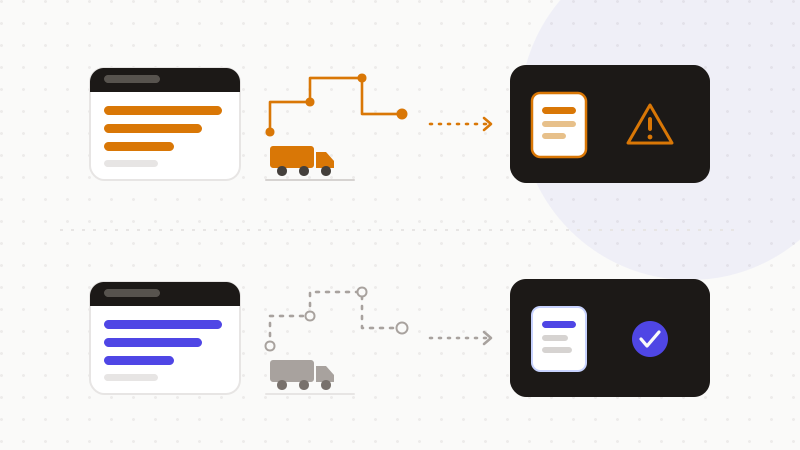
The principle is simple. Replace every sensitive value with a token before you send. The customer address. The carrier name. The rate. The origin site. The AI returns its plan with the tokens. You restore the real values afterwards, locally.
- 1Classify what may never leave: customer addresses, negotiated rates, site details.
- 2Replace those values with reversible tokens, in the browser.
- 3Send only the anonymized text to the model.
- 4Restore the real values in the reply, locally.
- 5Keep route and schedule detail out of public tools.
When a case genuinely needs real data, change tools. GDPR Article 28 governs the use of a processor. The relationship must rest on a contract or another legal act. That instrument sets the subject matter, duration, nature and purpose of the processing. And the processor acts only on documented instructions. "DPA" is industry shorthand for that instrument. The GDPR itself does not use the term. A consumer AI account opened by ticking a terms box is generally not offered on those terms. It is no substitute for a negotiated agreement. Article 5(1)(f) separately requires appropriate security and confidentiality.
That's what ONYRI Sanitize is for. The engine detects sensitive data — delivery addresses, customer names, carriers, amounts, sites — and replaces it with reversible tokens before sending. Detection and the mapping stay in your browser. Only anonymized text reaches the model. The AI optimises your plan without ever seeing the map of your business. You keep the help, without transmitting the personal data and the secrets that the GDPR, the NCSC and WIPO ask you to protect.
Frequently asked questions
- Is it safe to use AI for logistics and supply chain?
- Yes for method, no with your raw manifest. AI can optimise a route or draft a delay message with no real values at all. But don't paste customer addresses, negotiated rates or route detail into a consumer AI. The NCSC notes such queries are visible to the provider and are stored. Under the GDPR, a delivery address is personal data, and you remain the controller. Anonymise before you send.
- Is a delivery address personal data?
- Yes. GDPR Article 4(1) defines personal data as any information relating to an identified or identifiable person. A manifest line ties a name, a home address and a time window, so it fits that definition. Article 4(2) lists disclosure by transmission as processing. Pasting that list into an AI is therefore processing, and Article 5(2) requires you to account for it.
- Can pasting my freight rates into an AI cost them their secret status?
- That is the real risk. WIPO sets three conditions for a trade secret, including reasonable steps to keep the information secret. An uncontrolled prompt undercuts that condition. WIPO notes that once a secret is made public, anyone may access and use it at will. Your rates can qualify as a trade secret, but nothing guarantees it automatically — and disclosure ends the protection. Check the confidentiality clauses in your carrier contracts too.
Sources & references
- Regulation (EU) 2016/679 (GDPR) — official text: Art. 4(1) personal data, 4(2) processing incl. disclosure by transmission, 4(7) controller, Art. 5 principles, Art. 28 processor contract — EUR-Lex (Publications Office of the European Union)
- ChatGPT and large language models: what's the risk? — queries to public LLMs are visible to the provider, are stored, and should never contain sensitive information — UK National Cyber Security Centre (NCSC)
- Frequently Asked Questions on Trade Secrets — the three conditions, protected categories (supplier/client lists, distribution methods) and loss of protection on public disclosure — World Intellectual Property Organization (WIPO)
Keep your sensitive data in your browser
ONYRI Sanitize detects and masks your sensitive data before it reaches the AI, then restores the answer — from names to API keys.