Is It Safe to Use AI for Crypto?
Never paste your seed phrase or private key into any AI: they are the wallet and a leak is permanent. The one hard rule and the fix.
The answer comes down to one absolute rule. Never paste your seed phrase or private key into any AI. A seed phrase, also called a recovery phrase, IS your wallet. So is a private key. Anyone who sees them can drain your funds in an instant. And in crypto, there is no undo. An AI prompt travels to a company's servers. It may be stored there, then reviewed. AI stays useful for understanding crypto. But it never needs your keys. Ask general questions, and anonymise any address before you send.
Rule number one: the seed phrase IS the wallet
A seed phrase is a string of words. It rebuilds full access to your wallet. A private key does the same job. These two secrets are not ordinary passwords. They are total control of the funds. A serious exchange or wallet app will never ask you for them. Nor will any legitimate support team, in the spirit of the FTC's warnings.
Why does an AI change everything? A prompt travels. It leaves your device for a remote server. There, it can be kept and reviewed by humans. You lose control of the secret. And crypto has no undo button. The FTC notes these payments are not reversible. No chargeback, no easy recourse. A leaked key is an immediate, permanent loss.
AI-themed scams are everywhere
The hype around AI draws in fraudsters. The CFTC, the U.S. futures-market regulator, issued a customer advisory. Its message is blunt. “AI technology can't predict the future or sudden market changes.” Be wary of “AI trading bots” that promise huge returns.
The numbers these scams throw around are absurd. Returns of tens of thousands of percent. “100 percent win rates.” The CFTC describes real cases. Promoters guaranteed at least 10 percent a month, over 200 percent a year. They turned out to be Ponzi schemes. Victims lost tens of millions of dollars and nearly 30,000 bitcoins. Any guaranteed return is a red flag.
- An “AI trading bot” promising guaranteed or huge gains.
- “Connect your wallet to this AI helper.”
- “Paste your recovery phrase so the AI can help.”
- Anyone contacting you to “recover” lost crypto: the FTC warns no legitimate party does this.
AI-generated code can be booby-trapped
AI writes code on request. It can also produce code that is wrong or dangerous. A poorly built smart contract can be drained. A malicious wallet script can steal your keys. That is a real supply-chain risk, born of blind copy-paste. Never run code that touches a wallet without expert review. This caution is sound security practice, not a regulator's rule.
Pseudonymous does not mean anonymous
Bitcoin and most blockchains are pseudonymous. Not anonymous. A wallet address is a permanent identifier. The whole ledger is public and etched in forever. Chain-analysis firms follow funds hop by hop. As Elliptic, a blockchain-analytics firm, puts it: “Bitcoin is not anonymous.”
The link to your identity happens at a precise moment. At an exchange that applies KYC, the identity-verification check. Or when you hand over context yourself. Paste your address and your name into an AI, and you tie your whole on-chain history to you. Forever. That is why you must anonymise an address before any prompt.
| What you want to paste | The risk |
|---|---|
| A seed phrase or a private key | Total, immediate loss of the funds, with no undo |
| A wallet address + your name | Your entire on-chain history tied to you, for life |
| An “AI trading bot” that guarantees gains | A fraud signal, often a Ponzi scheme |
| Wallet code to run without review | Key theft or a contract drained by booby-trapped code |
The fix: keep your keys out of reach
Good news: AI is still useful in crypto. It can explain a type of trade. It can clarify how a wallet or a token works. For that, it needs none of your keys. Ask the question in general terms. Keep your seed phrase, private key and addresses out of the prompt.
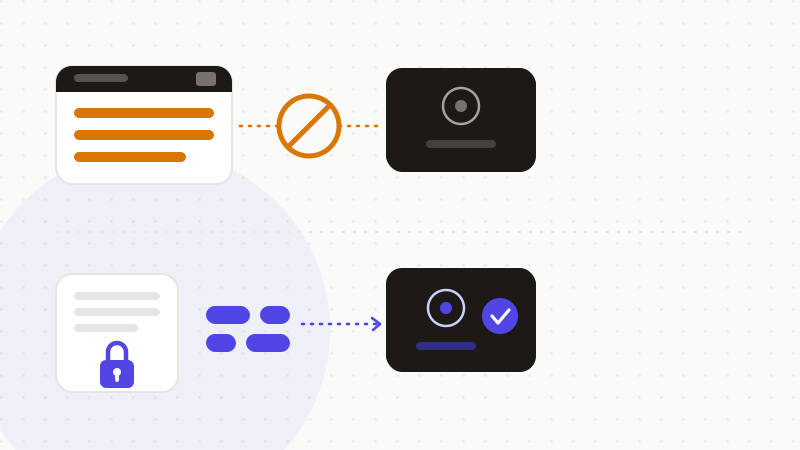
When you really must describe a real case, anonymise it first. Replace each address with a token. The AI reasons about the shape of your situation. It never sees the real values. You restore them afterwards, locally. And your keys never leave your control at all.
- 1Never paste a seed phrase or private key. Anywhere.
- 2Treat “AI trading bot” and “paste your phrase” as alarms.
- 3Never run wallet code without expert review.
- 4Anonymise any address or context before sending it to the AI.
That's what ONYRI Sanitize is for. The engine detects sensitive data — wallet addresses, amounts, names — and replaces it with reversible tokens before sending. Detection and the mapping stay in your browser. Only anonymized text reaches the model. And your seed phrases and private keys? They have no place in a prompt: keep them out of every tool, ONYRI included.
Frequently asked questions
- Is it safe to use AI for crypto?
- Yes for general questions, no with your secrets. AI can explain a trade, a wallet or a token with no sensitive data at all. But never paste your seed phrase or private key: they are the wallet, and a leak is permanent. Be wary of “AI trading bots” and anonymise any address before you send.
- Can I paste my seed phrase into ChatGPT if it's just for help?
- No, never. A seed phrase and a private key are the wallet itself. A prompt travels to servers where it can be stored and reviewed. No legitimate support or service asks for these secrets, in the spirit of the FTC's warnings. In crypto, a leak is immediate and permanent.
- Is a wallet address anonymous?
- No. Bitcoin is pseudonymous, not anonymous, as Elliptic points out. An address is a permanent identifier, and the ledger is public. Once an address is tied to your identity, your whole on-chain history follows you. Anonymise an address before pasting it into an AI.
Sources & references
- What To Know About Cryptocurrency and Scams (crypto is not reversible, never share your keys, recovery scams) — U.S. Federal Trade Commission (FTC)
- Customer Advisory: AI Won't Turn Trading Bots into Money Machines (AI can't predict markets, guaranteed returns = fraud) — U.S. Commodity Futures Trading Commission (CFTC)
- Bitcoin Is Not Anonymous (blockchain traceability, pseudonymous ≠ anonymous, chain analysis) — Elliptic
Keep your sensitive data in your browser
ONYRI Sanitize detects and masks your sensitive data before it reaches the AI, then restores the answer — from names to API keys.