Is It Safe to Use AI for Cleaning Services?
Yes for admin, no for access: never paste a client's address, access code and schedule together into a consumer AI. That trio is a real-world safety map.
Yes, AI can help a cleaning business. Quotes, schedules, client messages, marketing: it saves real time. But this trade carries a risk of its own. Your client file knows where the person lives. It knows how to get in: keys, alarm code, gate code, lockbox code. It knows when the home is empty. Paste those three together into a consumer AI, and you create a real-world safety risk, not just a privacy one. The rule is simple. Never put the address, the access code and the schedule in the same prompt. Access codes: never at all.
Why your client records are a burglary brief
No other trade holds these three facts at once. A cleaning business does. It knows the client's exact address. It knows the entry method. And it knows the timing: when the home is empty, when the visit happens. Taken alone, each fact looks harmless. Put together, they draw a map: where, how and when to enter someone's home.
An alarm or door code is not just another piece of data. It is a password that opens someone's home. It deserves the same care as a banking login. The FTC, the US consumer-protection authority, makes the point in its guide for business. It says to restrict access to sensitive information on a need-to-know basis. It says to control who holds the keys. An access code follows the same logic: hold it tightly, never share it casually.
Your client data is personal data
A client's name, address and phone number are personal data. The GDPR (Regulation (EU) 2016/679) protects them. So your client list is a regulated file. And the GDPR names you the 'controller': you decide why and how that data is used. That responsibility follows you everywhere.
Article 24 of the GDPR is clear. The controller must put appropriate technical and organisational measures in place. It must be able to show it complies with the law. You cannot hand off this duty. Pasting the data into a third-party tool does not erase it. The responsibility stays yours.
Your staff count too. A cleaner's schedule, contact details and hours are personal data. You are the controller for your team, just as you are for your clients. An AI that learns who works where and when is not a neutral thing.
Being a small business changes nothing. The ICO, the UK data-protection regulator, confirms this in its advice for small organisations. The law applies to any business, whatever its size. The meaning of personal data is broad. Only some documentation duties are lighter below 250 staff. The core duty stays whole.
What happens when you paste a file into AI
A consumer AI often ingests the text it receives for its own purposes. Unless a specific agreement, such as a Data Processing Agreement (DPA), says otherwise, nothing stops it. So pasting an address, an entry method and a schedule exports regulated personal data. And, unique to this trade, it hands over a real map: where, how and when a home can be entered.
Your data security does not stop at your office. The FTC describes four linked pillars. Physical security. Electronic security. Staff training. And the practices of your service providers. That last one matters here. The software you trust with your data is part of your own security. An AI without safeguards becomes a weak link.
| You assume | The reality |
|---|---|
| “A door code is just a number” | It's a password to a home: keep it out of every prompt |
| “My client list isn't regulated” | Names and addresses are personal data; you are the controller |
| “An AI seeing a schedule is harmless” | Address + access + timing together = a where, how and when map |
| “We're too small to be covered” | The ICO says size doesn't exempt you from controller duties |
The fix: anonymise before you send
Good news: AI is still useful for your business. It drafts a quote. It plans a route. It reviews a client message. For all of that, it needs no real access at all. Follow four simple principles and the risk falls away.
- Never combine address, access code and schedule in one prompt.
- Keep access codes fully out of the AI: treat them like passwords.
- Anonymise client identifiers before you write: the AI drafts the quote or route on neutral text.
- Prefer vetted tools covered by a Data Processing Agreement (DPA).
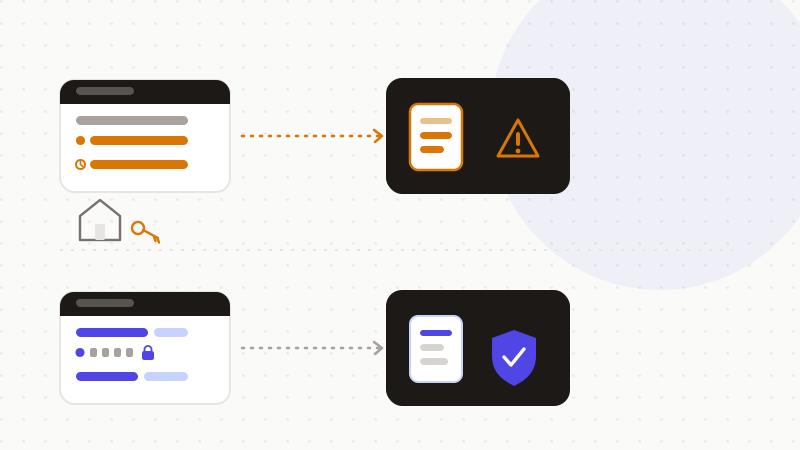
In practice, replace each identifier with a token before you send. The AI reasons about the shape of your request, without ever seeing the real values. You restore the real data afterwards, locally. Here is the method to follow.
- 1Spot the identifiers: client name, address, schedule.
- 2Replace them with reversible tokens, in the browser.
- 3Leave access codes out entirely, never in the prompt.
- 4Send the anonymised text, then restore the values locally.
That's what ONYRI Sanitize is for. The engine detects sensitive data — names, addresses, schedules — and replaces it with reversible tokens before sending. Detection and the mapping stay in your browser. Only anonymised text reaches the model. Access codes, though, never belong in a prompt: keep them apart, like passwords. You get the help of AI, without turning your client file into a burglary brief.
Frequently asked questions
- Is it safe to use AI for cleaning services?
- Yes for admin work, as long as you protect access. AI can draft a quote, a schedule or a client message with no sensitive data at all. But never paste a client's address, access code and schedule together into a consumer AI: combined, those pieces form a map of where, how and when to enter their home. Anonymise identifiers before you send, and keep access codes fully out of the prompt.
- Can I put an alarm code or lockbox code into ChatGPT?
- No. An alarm code, gate code or lockbox code is a password to a home. The FTC asks businesses to restrict access to sensitive information and to control who holds the keys. An access code follows the same logic: don't share it casually. Keep it out of any chatbot, always.
- Am I responsible for my clients' and staff's data?
- Yes. Under the GDPR, your clients' names, addresses and contact details are personal data, and you are the controller for them. Your staff's schedules and contact details are too. Article 24 requires you to put appropriate measures in place. The ICO confirms that being a small business does not exempt you from that duty.
Sources & references
- General Data Protection Regulation (Regulation (EU) 2016/679) — full text (controller, personal data, Article 24 measures) — EUR-Lex (Publications Office of the European Union)
- Protecting Personal Information: A Guide for Business (physical security, need-to-know access, controlling the keys) — U.S. Federal Trade Commission (FTC)
- Data protection principles, definitions and key terms (advice for small organisations: size does not exempt you) — Information Commissioner's Office (ICO), UK
Keep your sensitive data in your browser
ONYRI Sanitize detects and masks your sensitive data before it reaches the AI, then restores the answer — from names to API keys.
Anonymize my prompt