Is DeepSeek Banned in the UK? What You Need to Know
No, DeepSeek isn't banned for the UK public, but it's under scrutiny. Its privacy policy stores your prompts in China — anonymise first.
No, DeepSeek is not banned for the general public in the UK. At the time of writing, there is no nationwide ban on it for the UK public. But the tool is under scrutiny. The government has warned about data risks. Some public-sector or security contexts do restrict the app. One point matters whatever the legal status. DeepSeek's privacy policy states that your data, including your prompts, is stored on servers in China. So your inputs leave the country and fall under Chinese law. The fix is simple: don't paste personal or company data into it, and anonymise it before you send.
Is DeepSeek banned in the UK?
The answer fits in one line. As of early 2025, the UK imposed no nationwide ban on DeepSeek for the general public. The government warned about data risks. But it left usage as a personal choice. The AI minister urged people to stay alert to how their data is handled. The UK moved more cautiously than several of its peers.
- No nationwide public ban, at the time of writing.
- The government flagged data risks, without blocking access.
- The AI minister called for vigilance over how data is handled.
- Reporting indicates the app was restricted on some government devices.
- Officials also privately cautioned businesses about sharing information.
So the accurate framing is nuanced. DeepSeek is not banned for the public, but it is under scrutiny. It is also restricted in some public-sector or security contexts. That is not a blanket ban. The status can change, so check the latest position before you conclude.
How other countries and bodies reacted
Elsewhere, the response was firmer. The measures differ in kind. Only one is a real block ordered by a regulator. The others target public devices or specific agencies. The table below tells them apart.
| Country / body | Action taken (early 2025) |
|---|---|
| Italy — Garante (data regulator) | Block ordered in late January 2025; removed from Italian Apple and Google stores |
| Australia — federal government | Banned on all government systems and devices on 4 February 2025 |
| United States — NASA | Blocked from its systems on 31 January 2025 |
| United States — US Navy | Warned staff against using it |
| United Kingdom | No public ban; caution in some public-sector contexts |
Italy's reason is worth remembering. The Garante, Italy's data protection authority, acted for one simple reason. DeepSeek's policy says user data is stored in China. The regulator saw a GDPR problem there. That is the same point every UK user should weigh.
The real issue: your prompts stored in China
Here is the fact that holds whatever the legal status. DeepSeek's published privacy policy states it plainly. The personal data it collects, including your inputs, is stored on servers in the People's Republic of China. In other words, your prompts leave the UK. Once there, they fall under Chinese law. Whether or not a ban exists.
On the UK side, the data protection rules stay the same. The Information Commissioner's Office (ICO) is the UK's data protection regulator. It applies the UK GDPR, the UK version of the GDPR, to AI tools. Its approach is risk-based. Organisations must safeguard personal data and stay transparent about how it is processed. That expectation applies to any AI tool, DeepSeek included.
The fix: anonymise before you paste
The good news: you can still use the tool for general tasks. The risk is not the conversation. It is the data you leave in it. So keep your personal and company data out of the prompt. When you must include a concrete case, anonymise it first.
- 1Spot the sensitive data in your text: names, emails, amounts, clients, secrets.
- 2Replace each value with a reversible token, in the browser.
- 3Send only the anonymised text to the AI tool.
- 4Restore the real values in the reply, locally.
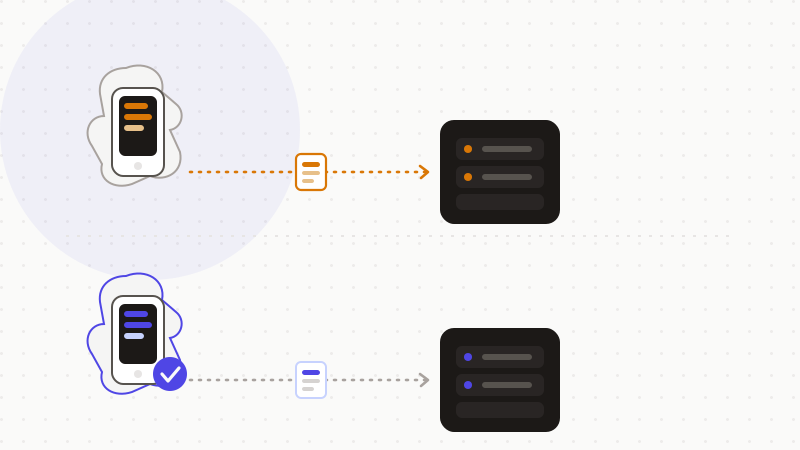
That's what ONYRI Sanitize is for. The engine detects sensitive data — names, emails, amounts, clients, secrets — and replaces it with reversible tokens before sending. Detection and the mapping stay in your browser. Only anonymised text reaches the model. Whether DeepSeek is banned or not, your sensitive data never leaves your browser. You get the help, without sending your identifiers to servers outside the UK.
Frequently asked questions
- Is DeepSeek banned in the UK?
- No, not for the general public. At the time of writing, the UK has imposed no nationwide ban on DeepSeek for the public. The government warned about data risks but left usage as a personal choice. Reporting points to restrictions on some government devices. The status can change, so check the latest position.
- Why did other countries block DeepSeek?
- The measures differ. Italy saw a real block: its regulator, the Garante, ordered it in late January 2025, and the app was pulled from Italian stores. Australia banned it on federal government devices. In the US, agencies such as NASA and the US Navy restricted its use. The recurring reason: DeepSeek's policy says data is stored in China.
- Is it risky to paste sensitive data into DeepSeek?
- Yes, better to avoid it. DeepSeek's privacy policy says your inputs are stored on servers in China, under Chinese law. So your prompts leave the UK, ban or no ban. Don't paste personal or company data. If you must describe a real case, replace the sensitive values with tokens first.
Sources & references
- Which countries have banned DeepSeek and why? (Italy / Garante, Australia, NASA, US Navy, data stored in China) — Al Jazeera
- UK Warns DeepSeek Users of Data Risks But Won't Ban It Yet (UK stance: warning, not a ban) — Claims Journal (Reuters)
- Artificial intelligence and data protection (UK GDPR principles applied to AI, risk-based approach) — Information Commissioner's Office (ICO)
Keep your sensitive data in your browser
ONYRI Sanitize detects and masks your sensitive data before it reaches the AI, then restores the answer — from names to API keys.