Is ChatGPT Legal in France?
No, ChatGPT is not banned in France: the CNIL did not block it. But the GDPR applies to you the moment you enter personal data into it.
No, ChatGPT is not banned in France. The answer sits in one nuance. The tool is legal to use. But the moment you enter personal data into it, the GDPR applies to you. The CNIL, the French regulator, never blocked the service. It chose to frame the technology rather than ban it. That is the opposite of Italy, where the Garante suspended ChatGPT in 2023. "Legal to use" does not mean "anything goes". The safest path stays simple: anonymise your data before the prompt.
Is ChatGPT banned in France? No
Let's start with the worry. ChatGPT is not banned in France. The CNIL never blocked the service. On 16 May 2023, it made a different choice. Rather than ban the tools, it launched an action plan on artificial intelligence. That plan has four strands. Its logic fits in one line: frame generative AI, do not outlaw it.
The CNIL did receive complaints. It has worked on the AI question. It still does. But at no point did it suspend ChatGPT in France. That is a real difference from some of its European neighbours.
The Italian case: the contrast with the Garante
Italy took another route. In March 2023, its data protection authority, the Garante, acted. After a data breach, it imposed a temporary block. The processing of Italian users' data by ChatGPT was suspended. It was a provisional measure, not a permanent ban. It was lifted after OpenAI made fixes.
France never took an equivalent step. No block, not even a temporary one. Hold on to the nuance: the Garante suspended, the CNIL framed.
"Legal" does not mean "anything goes"
Using ChatGPT is therefore legal. But the story does not end there. The moment you enter personal data, the GDPR applies. And it applies to you, not only to OpenAI. The CNIL points to three key requirements.
- A lawful basis: every processing must rest on one of the grounds set out by the GDPR.
- A specified purpose: you process the data for a precise, stated goal.
- Minimisation: process only the data strictly necessary for that goal.
That last principle is central. Minimisation asks you to limit data to the strict minimum. Yet a prompt often holds far more than that. A name. An address. A social security number. All data the model has no need to see.
| Common belief | What the facts say |
|---|---|
| "ChatGPT is banned in France" | False: the CNIL never blocked the service, unlike Italy's Garante |
| "It's legal, so I can put anything in it" | No: once there is personal data, the GDPR applies to you |
| "OpenAI was cleared by the courts" | Careful: the fine was annulled on jurisdiction, not on the merits |
| "Minimisation doesn't concern me" | It does: it asks you to keep data to the strict minimum |
The €15 million fine and its annulment
OpenAI's GDPR compliance has been contested. In late 2024, in December, the Italian Garante struck hard. It fined OpenAI 15 million euros. The grounds were multiple. A lack of lawful basis for training. A failure to inform people. No age verification. And no notification of the 2023 breach.
Then came a reversal. Around March 2026, the Court of Rome annulled the fine. Note the exact ground. The annulment rests on jurisdiction, not on the merits. OpenAI's Irish establishment becomes the lead authority, under the EU one-stop-shop. The court did not rule on the alleged breaches. In other words, OpenAI was not cleared. The substantive question stays open.
One more point calls for caution. Your data travels to OpenAI's servers in the United States. That transfer relies on the EU–US Data Privacy Framework. The European Commission judged it adequate in July 2023. But its validity is still contested in court. Here too, nothing is settled for good.
Confidentiality-bound professions: heightened caution
Some professions must be doubly careful. Lawyer–client privilege is one. In France it flows from article 66-5 of the law of 31 December 1971 and the CNB's rules (Conseil national des barreaux, the national bar council). Medical confidentiality is another, set out in article L.1110-4 of the Public Health Code. Then there is health-data hosting. It must go through an HDS-certified host (hébergeur de données de santé, a certified health-data host), under article L.1111-8 of the same code.
The rule is simple for these professions. Never hand data covered by secrecy to an unframed third-party service. A consumer AI chatbot falls into that category. Here, caution is not optional — it is an ethical duty.
The fix: anonymise before the prompt
Good news: you can keep the AI. It answers general questions very well. It explains a rule, a calculation, a draft letter. For that, it needs none of your personal data. Keep it out of the prompt.
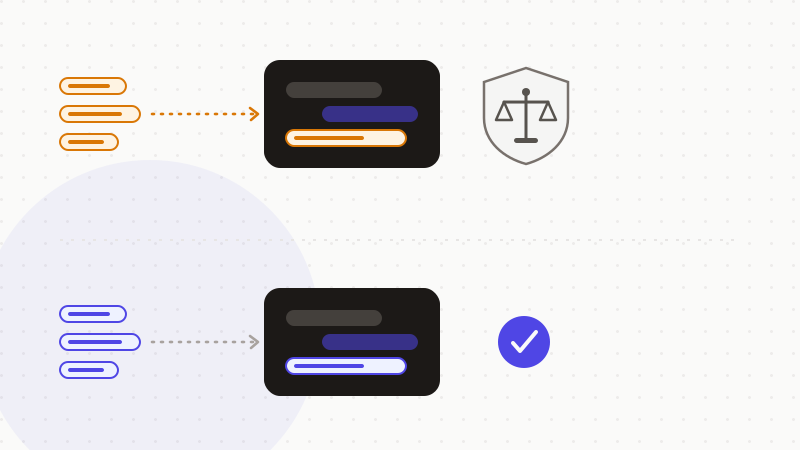
When a concrete case is needed, anonymise first. Replace each sensitive value with a token. The model reasons about the structure, never about the real values. You restore the real values afterwards, locally.
- 1Spot the personal data in your text: names, addresses, numbers.
- 2Replace them with reversible tokens, in the browser.
- 3Send only the anonymized text to the model.
- 4Restore the real values in the reply, locally.
That's what ONYRI Sanitize is for. The engine detects sensitive data — names, addresses, numbers, secrets — and replaces it with reversible tokens before sending. Detection and the mapping stay in your browser. Only anonymized text reaches the model. You apply the minimisation the GDPR expects, without giving up AI. Legal to use, yes — and minimised, just as the CNIL reminds us.
Frequently asked questions
- Is ChatGPT legal in France?
- Yes, ChatGPT is legal to use in France. The CNIL never banned or blocked it, unlike Italy's Garante in 2023. But "legal to use" does not mean "anything goes". The moment you enter personal data, the GDPR applies to you: lawful basis, purpose and minimisation. The safest path is to anonymise your data before the prompt.
- Did the CNIL ban ChatGPT?
- No. The CNIL never blocked ChatGPT in France. On 16 May 2023, it launched a four-strand action plan on artificial intelligence, framing the technology rather than banning it. It received complaints and worked on the topic, but it did not suspend the service — unlike Italy, where the Garante imposed a temporary block in 2023.
- Does the fine against OpenAI mean you should avoid ChatGPT?
- Not exactly. Italy's Garante fined OpenAI 15 million euros in late 2024. That fine was later annulled, around March 2026, by the Court of Rome. Careful: the annulment rests on jurisdiction (the Irish establishment becoming lead authority), not on the merits. The court did not rule on the alleged breaches, so OpenAI was not cleared. So: caution, and data minimisation.
Sources & references
- Artificial intelligence: the CNIL's action plan (16 May 2023, four strands, framing rather than banning) — CNIL
- Italian court annuls the €15M fine against OpenAI — a jurisdiction ruling, not on the merits — PPC Land
- Lawful bases: defining the lawful basis of a processing (purpose, minimisation) — CNIL
Keep your sensitive data in your browser
ONYRI Sanitize detects and masks your sensitive data before it reaches the AI, then restores the answer — from names to API keys.