AI and UK Financial Data: What the FCA Expects
The FCA doesn't ban AI but holds firms to existing rules. Don't paste client financial data into consumer AI — anonymise it before the prompt.
Here is the honest answer. The FCA (Financial Conduct Authority, the UK's financial regulator) does not ban AI. It takes a technology-neutral, outcomes-based approach. But it holds your firm to the rules you already follow. So pasting a client's account number, sort code or balance into a consumer AI tool is not illegal by itself. It is a risk. It can cut against the Consumer Duty, your SYSC (systems and controls) duties and UK GDPR. The fix is simple. Anonymise the sensitive details first. Then use AI on the structure of the task, not on the raw client data.
What the FCA actually expects
The FCA regulates financial firms in the UK. It has said clearly that it will not write a separate AI rulebook. Instead, it applies the framework you already know. This is called a technology-neutral, principles-based approach. In plain terms: AI is a tool, and the existing rules still apply to it.
The regulator also calls itself pro-innovation. It wants firms to use AI. It runs initiatives like its AI Lab and AI live testing to learn from real-world use. But that support comes with a condition. Your firm stays accountable for the outcomes the AI produces. You cannot blame the tool.
What a client financial record exposes
Think about what sits in a single client file. Every one of these details is personal data. And they are exactly what a fraudster wants.
- Account numbers and sort codes.
- Balances and transaction history.
- Pension and investment details.
- National Insurance numbers.
- Names, addresses and dates of birth.
Paste that into a consumer chatbot. It can be retained, reviewed or reused for training. You lose control of where it goes.
Accountability does not transfer
This is where the FCA's rules bite. The Consumer Duty asks firms to act to deliver good outcomes for retail customers. You cannot hand that duty to a supplier. If an AI tool mishandles client data, the responsibility is still yours.
The SYSC and operational resilience rules point the same way. They expect proper governance over technology and over third parties. A consumer AI tool is, in effect, a third-party service. Using it does not remove your duty to oversee and manage the risk.
Then there is SM&CR (the Senior Managers and Certification Regime). It puts a named senior manager on the hook. So this is not an abstract compliance point. A real person is personally accountable for how client data is handled.
UK GDPR and the ICO: financial data is personal
Data protection law says the same thing from another angle. The ICO (Information Commissioner's Office) is the UK's data regulator. It treats personal data used in AI as fully covered by UK GDPR. Financial details are personal data. So pasting them into an AI tool is a processing activity that must meet the law.
The ICO uses a risk-based approach. Where AI processing is likely to result in high risk to people, UK GDPR (Article 35) can require a Data Protection Impact Assessment first. This does not apply to every AI use. But it can apply to sensitive client financial data. The ICO even publishes an AI and data protection risk toolkit to help you assess it.
The FCA and the ICO have been working together on this. They treat data protection and consumer protection as connected, not separate. So there is no gap to hide in.
| You assume | The reality |
|---|---|
| “The FCA bans AI, so we can't use it” | The FCA is technology-neutral and supports AI use |
| “Using an AI vendor moves the risk to them” | SYSC keeps oversight of third parties with your firm |
| “A chatbot seeing a balance is harmless” | Financial details are personal data under UK GDPR |
| “Compliance is the whole firm's problem” | SM&CR names a senior manager as personally accountable |
The fix: anonymise before you send
Good news: AI is still useful in a regulated firm. It can draft a client letter, summarise a policy, or restructure a note. For that, it does not need the real account numbers. It needs the shape of the task.
When a real case has to go in, anonymise it first. Replace each sensitive identifier with a token. The AI works on the structure. You restore the real values afterwards, on your own machine.
- 1Find the sensitive identifiers: account numbers, sort codes, balances, NINos, pension details.
- 2Replace them with reversible tokens, in the browser.
- 3Send only the anonymised text to the AI.
- 4Restore the real values in the reply, locally.
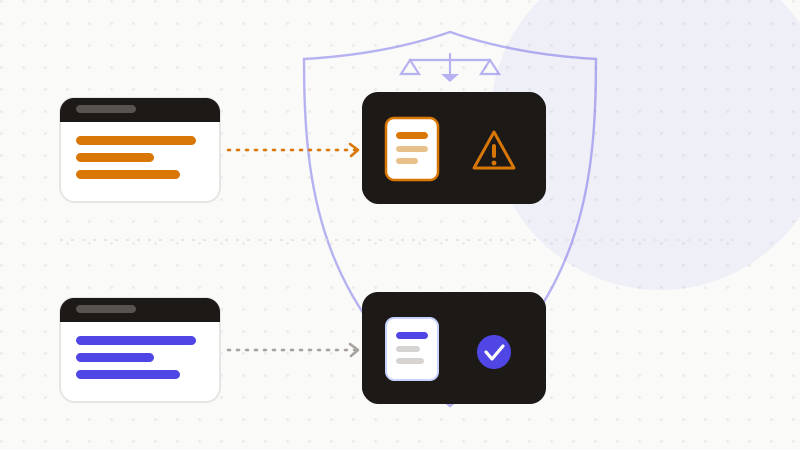
That's what ONYRI Sanitize is for. The engine detects sensitive data — account numbers, sort codes, balances, pension details, National Insurance numbers — and replaces it with reversible tokens before sending. Detection and the mapping stay in your browser. Only anonymised text reaches the model. The AI finds only tokens, never your client's real financial data. You get AI's help while keeping the control the FCA and the ICO expect of you.
Frequently asked questions
- Is it safe to put UK financial data into AI, and what does the FCA expect?
- The FCA does not ban AI: it is technology-neutral and holds you to existing rules. You stay accountable for the outcomes AI produces. Pasting clients' account numbers, sort codes, balances or National Insurance numbers into a consumer AI can cut against the Consumer Duty, SYSC and UK GDPR. Good practice is to anonymise that data before the prompt, then use AI on the structure of the task.
- Does using an AI vendor move the risk away from my firm?
- No. Under SYSC and the operational resilience rules, a consumer AI tool is a third-party service, and oversight stays with you. SM&CR goes further: it names a senior manager as personally accountable. The vendor does not take on your regulatory responsibility.
- Is a Data Protection Impact Assessment always required to use AI?
- Not always. UK GDPR (Article 35) requires a DPIA where processing is likely to result in high risk to people. That can cover sensitive client financial data, but not every AI use. The ICO provides a toolkit to help you assess and document that risk.
Sources & references
- AI and the FCA: our approach (technology-neutral, outcomes-based, pro-innovation, AI Lab) — Financial Conduct Authority (FCA)
- Consumer Duty (higher standard of good outcomes for retail customers) — Financial Conduct Authority (FCA)
- Guidance on AI and data protection (UK GDPR applied to AI, risk-based approach, DPIA, toolkit) — Information Commissioner's Office (ICO)
Keep your sensitive data in your browser
ONYRI Sanitize detects and masks your sensitive data before it reaches the AI, then restores the answer — from names to API keys.